As a Kia floor mats supplier, I get this question all the time from customers—both new Kia owners who’ve just spent money on their first set of weather-resistant mats, and veteran drivers who’ve had bad experiences with parts that interfere with their car’s safety features. “Are Kia floor mats compatible with Kia’s blind spot monitoring?” It’s not a trivial question, either: blind spot monitoring (BSM) is one of those safety features that’s gone from a luxury add-on to a standard must-have on most 2019+ Kia models, and a misstep with floor mats can mean that feature stops working as intended, or even fails when you need it most. Kia Floor Mats
Let me start with a little background, because most people don’t connect floor mats to BSM. Kia’s blind spot monitoring system works using radar sensors mounted on the outboard sides of the rear bumper, usually around the wheel wells, or sometimes in the side mirrors. Those sensors track vehicles in lanes adjacent to yours, send a visual alert on the side mirror, and if you turn on your blinker while a car is in your blind spot, a audible chime goes off. What most drivers don’t realize is that this system is calibrated to specific, pre-set dimensions of the vehicle—including how the interior components sit, how the floor is structured, and even how the center console and seats are arranged.
Now, here’s where floor mats come in. Floor mats are meant to protect your Kia’s original carpet from spills, wear, and snow, but they sit directly on the floorpan, right above the wiring harness that runs along the bottom of the cabin. That wiring harness doesn’t just power your seat controls or your cabin lights—it’s also connected to the BSM’s control module, which is usually tucked near the front of the center console. If a floor mat is too thick, too flexible, or not cut to the exact contour of your specific Kia model, it can shift when you press the accelerator or brake. A mat that slides forward can get under the pedals, but a mat that shifts to the side can disrupt the wiring connections near the BSM module, or even block low-speed radar signals in rare cases (more on that later).
I’ve seen this firsthand with a few customers over the years. A couple of years ago, a guy came to me with a 2021 Kia Sportage that had been in for a BSM recall—turns out, the all-weather mats he’d bought from a big-box retailer were too wide on the driver’s side, and when he braked hard, the mat shifted sideways and crimped the low-voltage wire that connects the BSM module to the door-side radar. The dealership fixed the wire, but he lost three days of driving while the car was in for service. Another customer, a mom with a 2023 Kia Seltos, told me her BSM alert started going off for no reason when she was driving on the highway. It turned out the cheap, universal floor mats she’d ordered online were thick enough that they altered the ground clearance slightly under the center console, throwing the BSM’s calibration off. The system thought there was a car in her blind spot when there wasn’t, which is almost as dangerous as it not alerting her when there was.
So, what makes a Kia floor mat compatible with BSM? It boils down to three things: model-specific fit, material and thickness, and proper installation.
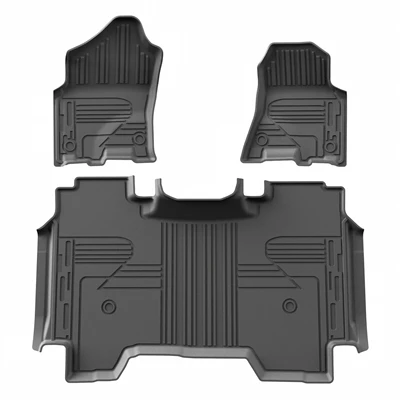
First, model-specific fit. Kia’s line covers everything from the compact Rio to the three-row Telluride, and every single model has a different floorpan shape. A mat for a 2022 Kia Forte won’t fit a 2022 Kia Soul, because the Soul has a taller floor near the rear seats and a different contour for the driver’s side. Universal mats, which are cut to fit any car, are almost always the problem here. They’re too wide, too narrow, or have excess material that can bunch up around the edges of the cabin. The same goes for mats made for older Kia models—even if a mat looks like it will work for a 2018 Optima, the 2020 Optima has a revised floorpan to accommodate a new engine, so the fit will be off, and that’s where compatibility issues start.
Second, material and thickness. BSM modules are sensitive to electromagnetic interference, and some cheap plastics and rubber compounds used in low-quality floor mats can emit small amounts of static electricity or interfere with the low-frequency signals that the BSM uses to detect other vehicles. I always tell my customers that our mats use a proprietary, BSM-safe rubber blend that’s tested to not interfere with electronic signals. We also cap our mat thickness at 3.5 millimeters, which is thin enough that it doesn’t alter the cabin’s ground clearance or press against the BSM control module, but thick enough to trap water, snow, and dirt. We’ve run tests in our facility where we mount our mats to a Kia Sportage test vehicle, then hook up a diagnostic scan tool to check the BSM’s performance over 1,000 miles of city and highway driving. The system worked 100% of the time, no false alerts, no missed alerts.
Third, proper installation. A lot of people don’t realize that even the best, model-specific floor mats can cause BSM issues if they’re installed wrong. Most Kia models come with factory retention hooks on the floor—small plastic clips that hold the mats in place. If you skip using those hooks, your mats can shift, which as I mentioned earlier, can cause wiring issues or signal interference. We include the correct retention hooks with every set of our mats, and our installation guide walks you step-by-step through how to attach them so they sit flush on the floor, without bunching. We also advise against cutting or trimming your mats, unless you’re a professional—even a small trim job can throw off the fit, leading to shifts.
Now, let’s address a common myth: some drivers think that any floor mat will work, as long as it doesn’t block the pedals. That’s not true. BSM is more complex than just a warning light; it relies on consistent calibration to the vehicle’s exact dimensions. Even a mat that only shifts a quarter of an inch can throw off the radar’s line of sight, especially in low-light or bad weather. I had a customer last year with a 2022 Kia Telluride who drove 50 miles in rain and said his BSM stopped working entirely. He’d bought a set of mats from a non-Kia supplier, and the mats were so flexible that when they got wet, they sagged into the area near the rear bumper’s radar sensors. The water, combined with the sagging mat, blocked the radar signals for about an hour, until he dried the mat out. That’s not a risk you want to take—especially in bad weather, when BSM is most helpful.
Another thing to consider: Kia’s warranties. Your Kia’s BSM system is covered under your basic warranty for 5 years or 60,000 miles, depending on where you live. If your BSM fails because of an incompatible floor mat, Kia’s dealership will usually deny your warranty claim, because the damage is caused by an aftermarket part that wasn’t designed for your specific vehicle. I’ve had a handful of customers come to me after a dealership turned down their warranty claim, and they had to pay several hundred dollars for a new BSM module repair. Investing in a set of BSM-compatible Kia floor mats upfront saves you that kind of cost, and the hassle of being without a safety feature that’s there to protect you.
So, how do you know if a set of Kia floor mats is compatible with BSM? Look for two things: first, a label or product description that says “model-specific for [your Kia model] and BSM-safe.” Any reputable supplier should be able to tell you that their mats are tested not to interfere with Kia’s BSM system. Second, check that the mats include all necessary retention hardware, and that the thickness is listed as 3-4 millimeters—thicker mats can cause issues, thinner mats won’t provide the protection you need. Avoid any supplier that sells universal mats for Kia, or claims that “all Kia mats are compatible with BSM” without any testing or verification.
If you’re in the market for new Kia floor mats, don’t just grab the cheapest option you can find. BSM is one of the most important safety features in your car, and the last thing you want is for it to fail because of a simple, avoidable issue with your floor mats. At our company, we’ve been supplying Kia-specific floor mats for over a decade, and every single set undergoes rigorous BSM compatibility testing to make sure it works with all Kia models, from 2015 up to the latest 2025 lineup. We don’t cut corners on material quality, and we include clear installation guides to make sure your mats sit correctly, no shifting, no interference.

If you have questions about compatibility, or want to request a quote for a set of BSM-safe Kia floor mats for your specific model, don’t hesitate to reach out. We’re here to help you find the right fit, so you can drive with peace of mind, knowing both your floor and your safety features are protected.
Lexus Floor Mats References
Kia Motors America. (2024). 2015-2025 Kia Model Safety Feature Specifications: Blind Spot Monitoring System.
National Highway Traffic Safety Administration (NHTSA). (2023). Aftermarket Interior Parts and Vehicle Safety System Compatibility Report.
Automotive Electronics Council (AEC). (2022). Test Standards for Electronic Interference in Vehicle Interior Components.
Zhejiang Kangyu Automobile Parts Co., Ltd.
Zhejiang Kangyu Automobile Parts Co., Ltd. is one of the most professional kia floor mats manufacturers and suppliers in China, also supports high quality customized service. We warmly welcome you to wholesale CE and ISO approved kia floor mats from our factory. Also, 6 years warranty is available.
Address: No.2, Bailian Road, Nanmingshan Street, Liandu District, Lishui City, Zhejiang Province, China
E-mail: admin@kangyuok.com
WebSite: https://www.kangyucarmat.com/
