Hey everyone, it’s Alex from your go-to solar stamping parts supplier, and today I’m tackling a question I get nonstop from installers, project managers, even some new solar homeowners: Do solar stamping parts include grounding components? Let’s cut to the chase here—this isn’t a yes/no answer, and I’m gonna break down why it matters, what you need to know, and how we at the shop make sure our parts play nice with all those critical electrical rules. Solar Stamping Parts

First, let’s get on the same page about what solar stamping parts are. When you’re setting up a solar panel array, you’ve got all those metal bits that hold everything together: the racking brackets that clamp panels to the rails, the rail connectors that link sections of racking, the mounting feet that attach rails to your roof or ground mount, even the trim pieces that finish off edges. Stamping is how we make ’em—punching metal (usually galvanized steel or aluminum, since they’re rust-resistant) into exact shapes fast, which is why stamping is perfect for solar parts, no fancy machining needed.
Now, grounding. I don’t need to tell anyone in the solar space why grounding’s a big deal. If lightning hits your array, or there’s a fault in the wiring, you don’t want that electricity bouncing around your roof or your equipment. Grounding provides a safe path for current to flow straight to the earth, no damage to panels, inverters, or—way more important—no risk of someone getting shocked. The National Electrical Code (NEC) in the U.S. lays this out pretty clearly (we follow NEC to the letter here, fyi), but a lot of folks mix up “structural racking” and “grounding components.” That’s where the confusion starts.
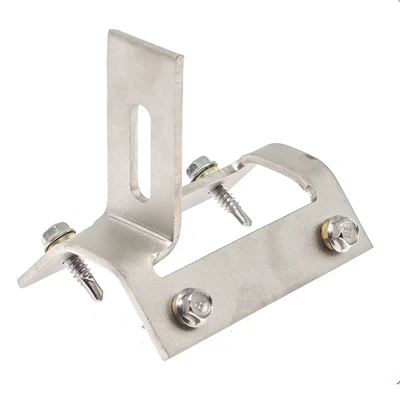
Wait, so do our stamping parts count as grounding components? Let’s be real: a plain stamped aluminum rail connector isn’t a dedicated grounding lug. But here’s the trick—most of the stamping parts we supply are designed to double as part of the grounding system, as long as they’re installed right. Let’s take an example: our solar mounting feet. The stamping process lets us build in a small, pre-punched tab or a slot for a grounding wire terminal. When you bolt the foot to the rail and clamp it to the roof, that tab creates a metal-to-metal connection between the foot, rail, and the building’s (or ground’s) grounding system. That’s not just a structural hold—that’s grounding in action.
But here’s the fine print. Not all stamping parts are created equal. If you’re buying cheap, generic stamped brackets from some random supplier off a catalog, they might not have that pre-punched tab. They’re just meant to hold things up, not carry current. At our shop, we design every stamping part with grounding in mind because we know installers don’t wanna stop mid-job to drill a hole for a ground wire. That’s a time sink, and time is money on a solar site. So every part we stamp has at least one approved connection point—either a threaded hole for a lug, a slot for a ring terminal, or even a built-in splice tab that’s already flush with the part so you don’t have to grind edges down.
Now, let’s clear up the myth that “grounding has to be a separate part.” Yeah, there are dedicated grounding lugs and bus bars that you can buy separately, but when you’re using stamping parts for racking, those parts are the primary conductors for the array’s grounding system. The NEC actually specifies that metal racking that connects multiple panels is considered a grounding electrode conductor if it’s the right size. So if your stamping parts are made of aluminum or galvanized steel (both good conductive metals) and connected properly to a main ground bus, that’s exactly what the code’s talking about.
I’ve seen too many guys cut corners here, though. A few months back, an installer brought us a bunch of messed-up stamped rail connectors—they’d drilled their own holes for ground wires, and the holes were too close to the edge, so the metal cracked. That broke the electrical connection, and when the inspector came around, they failed the whole array. Ugh. That’s why our stamping parts are tested to make sure those grounding tabs are placed exactly where they need to be—no cracking, no loose connections, just solid metal all the way through. We even add a thin layer of zinc coating during stamping (or anodizing for aluminum) to prevent corrosion, which is key because if your ground connection rusts out, it’s useless.
Another point: ground mount vs. roof mount. Our stamping parts for ground mounts are a little different because they’re dealing with more exposed metal. The base plates we stamp for ground mounts have extra grounding tabs on all four corners, so you can run multiple ground wires if you’re working on a big array (like 100+ panels for a commercial site). For roof mounts, we make sure the mounting feet are insulated from the roof itself (usually with a rubber pad) but still have that conductive path to the rail—so the roof doesn’t become part of the electrical system. That’s a balance, and it’s all part of how we design our stamping parts, not just how we stamp ’em.
Wait, what about negative grounding? Some smaller solar setups use the panel’s negative terminal as part of the ground. Does that play into stamping parts? Yep. The rail connectors we stamp are made to carry that low-voltage current, so they have to be tight-fitting—no gaps, no flimsy metal. If a connector is loose, it causes resistance, which can overheat. That’s a fire hazard, and we never want that. So our stamping process uses exact tolerances—like, within a thousandth of an inch—so every connector slides onto the rail and locks in perfectly. No play, no resistance, just smooth current flow.
I get why some people think solar stamping parts don’t include grounding components. It’s easy to see a bracket and think “that’s just metal to hold stuff.” But the reality is, 90% of the stamping parts we supply are integral to the grounding system. The only time they’re not is if you’re using a weird, non-conductive stamping material—we never do that, by the way. All our parts are conductive enough to meet NEC standards, because we don’t sell parts that cut corners on safety.
Now, let’s talk about what you should look for when ordering solar stamping parts. First, ask the supplier if their parts have pre-approved grounding connection points. Don’t assume—some cheap brands skip that to save a buck. Second, ask about material: aluminum is better for grounding than steel because it doesn’t corrode as fast, but galvanized steel works too, as long as it’s hot-dip galvanized (not a thin electro-plate that will chip). Third, check if the parts are tested for electrical conductivity. A lot of suppliers don’t do this, but we test every batch—we run current through the parts to make sure there’s no drop, no resistance.
At the end of the day, the worst mistake a solar installer can make is separating structural parts from grounding parts. They’re not two separate things—they’re one system. Our stamping parts aren’t just brackets to hold panels up; they’re the backbone of your array’s electrical safety. That’s why we put so much effort into designing ’em with grounding in mind, not just stamping ’em to fit a shape.
If you’re an installer, a project manager, or even a homeowner putting together a small off-grid system and you’re not sure what stamping parts you need—hit us up. We don’t just sell parts; we’ll walk you through which ones have the right grounding features, which ones work for your roof or ground mount, and even give you tips on how to install ’em so you pass inspection on the first try. No fluff, no sales pitch—just real info from someone who’s been stamping solar parts for 10 years and knows the ins and outs.
Don’t risk your array’s safety by buying parts that don’t get grounding. Reach out, tell us your project, and we’ll hook you up with exactly what you need.
Garden Tool Parts References
National Electrical Code (NEC) 2023 Article 250 (Grounding and Bonding)
Solar Energy Industries Association (SEIA) Racking Standards for Grounding Components 2022
International Code Council (ICC) Solar Installation Safety Guidelines 2021
Ningbo New Fanfeng Tools Co., Ltd.
With abundant experience, we are one of the most professional solar stamping parts manufacturers and suppliers in China. Please rest assured to buy bulk customized solar stamping parts at competitive price from our factory. If you have any enquiry about quotation, please feel free to email us.
Address: No.18, Zhangjia Industrial Zone, Shangtian Subdistrict, Fenghua District, Ningbo City
E-mail: 13081992660@163.com
WebSite: https://www.cnnewfanfeng.com/
